The Environmental Cost of New Waterfront Development
- Dr. Chafia Ferhat
- November 6, 2012
- Sustainability
- Asia, ecology, environment, FENN DESIGNERS, land mass, Land Reclamation, Mongabay.com, Sand, settlements, Singapore, The Palm Island, The World Dubai, water, Waterfront Development, Waterfront places
- 0 Comments
Human settlements developed and expanded near water for centuries, When roads were primitive, water was a source for food, agriculture, transportation, materials, trade, people well being and prosperity. No wonder that most of the world greatest cities are built along major rivers and seashores. Bangkok, London, Paris, Venice like many others waterfront cities have developed over the centuries to become major metropolitan which no longer depended on their water front for food, agriculture, or transportation of goods. The waterfront element though still make these cities the most attractive in the world. They offer ample opportunity for water activities, entertainment and tourism.
In comparison the new waterfront places being built around the world through sea reclamation as in the case of Dubai, Singapore, Hong Kong are created for totally different reasons. Waterfront properties cost soared exponentially over the years, lack of land and increasing urbanisation are the most …. reasons. But what are these waterfront developments environmental costs.
Let’s look at some examples.
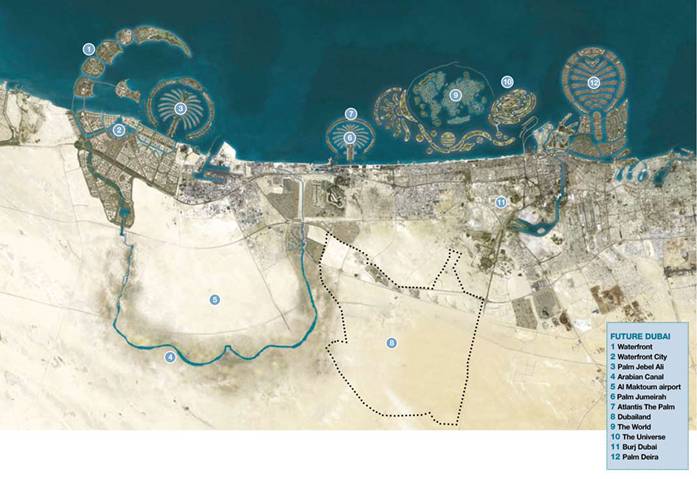
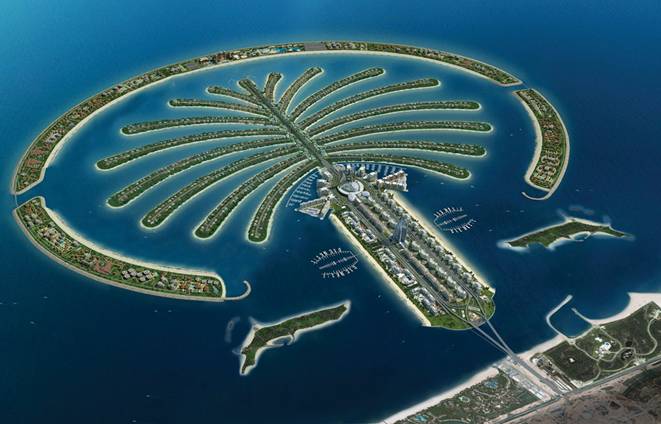
The Palm Island and the World Dubai, both projects are of such magnitude that no one doubts the major impact they have on the environment;
Mongabay.com, a site dedicated to rain forest conservation views on that;
“significant changes in the maritime environment [of Dubai] are leaving a visual scar [. . .] As a result of the dredging and re-depositing of sand for the construction of the islands, the typically crystalline waters of the gulf of Dubai have become severely clouded with silt. Construction activity is damaging the marine habitat, burying coral reefs, oyster beds and subterranean fields of sea grass, threatening local marine species as well as other species dependent on them for food. Oyster beds have been covered in as much as two inches of sediment, while above the water, beaches are eroding with the disruption of natural currents” (“Dubai’s artificial islands have high environmental cost”.
Singapore ever increasing land mass
The densely populated state of Singapore has expanded in size by more than 20 per cent since 1960 by reclaiming huge area of land from the sea. For that they need a LOT of sand, this sand is all imported from poor South East Asian like Cambodia, 796,000 tonnes of sand are still being extracted and exported to Singapore every year from just one province, Koh Kong.
According to theecologist.com,
“The extraction is coming at a significant environmental cost. Dredging reduces water quality by increasing turbidity, blocking sunlight and killing off plant life, including seagrass and coral. Sand extraction also disrupts natural sedimentary regimes causing increased erosion and greater flood risks. There have also been reports of significant declines in fish stocks.”
This land reclamation is very popular in Asia because of its growing urban population but it all comes at a cost. It is happening in Hong Kong, Japan, Taiwan, China and to a very large scale in South Korea who is undertaking the world largest reclamation at 40,100 hectares in Saemankeum.
Despite the major outcry from ecologists, environmentalists and anyone concerned with the world we are leaving for future generations, land reclamation is anything but slowing down, it is in fact accelerating not only to satisfy the ever increasing thirst for land for some but the completely outrageous audacity of others.
I just could not leave your site prior to suggesting that I actually enjoyed the usual information a person supply…
This is fantastic! Keep up the good work. ❤️
It's interesting to see how glass can be used in so many ways to be converted into art. My husband…